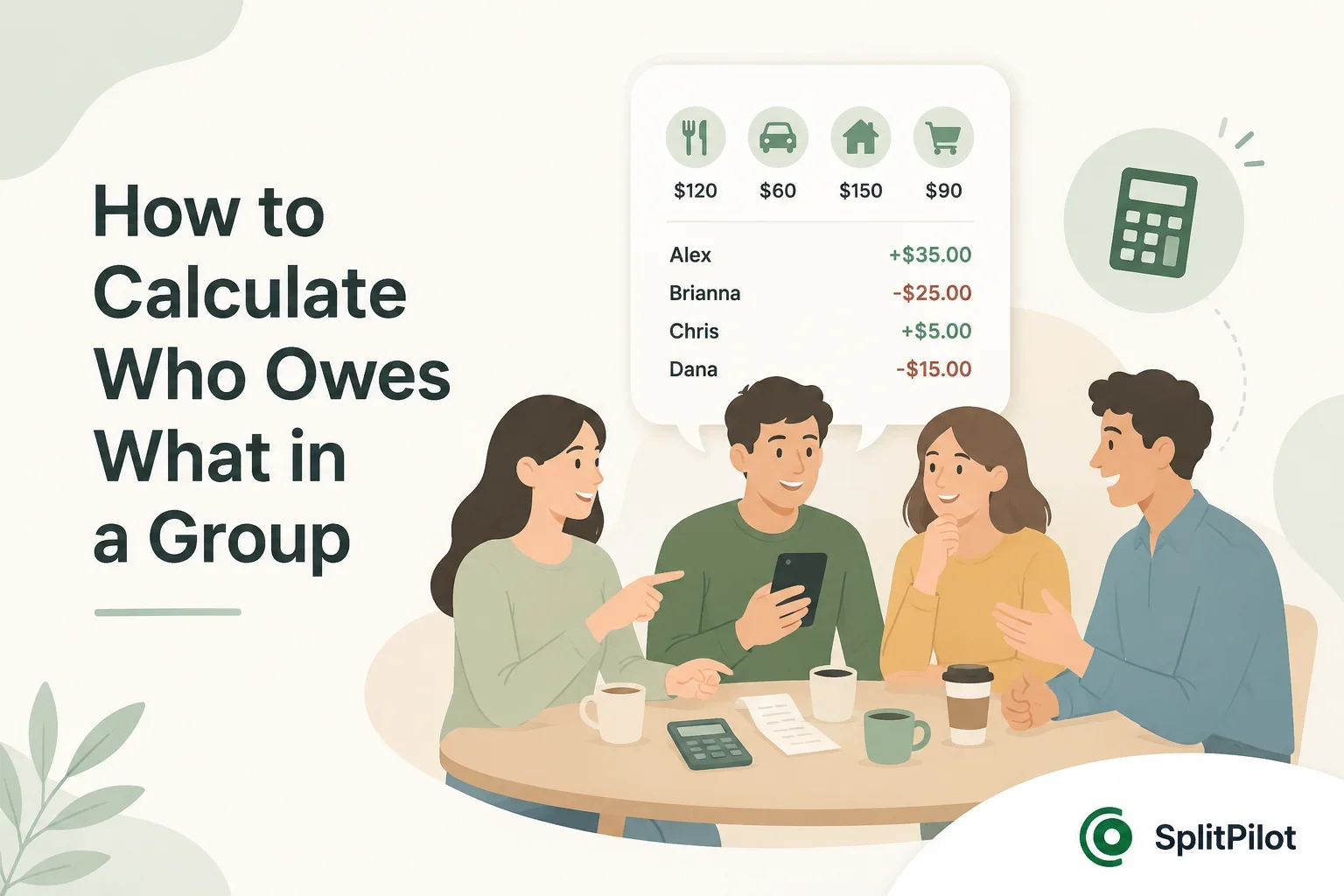
Deciding who owes what can become a bit of a mess, whether you're traveling with friends or sharing an apartment, organizing an event or running your household budget. If more than one individual makes multiple payments made at varying intervals, it can be difficult to track balances manually. With a simple process, it's quite easy to calculate shared expenses, fortunately.
Step 1: The first step involves recording all shared expenses. Record all shared expenses
The first is to maintain a complete record of all the shared expenses. All payments, made in the name of the group, should be recorded, along with who paid and how much was spent.
For example:
Alex paid $120 for dinner.
One of the trip costs to Sarah is $80 for transportation.
Mike spent $100 for his lodging.
The more precise your records are, the easier it will be to make balances at a later date.
Step 2: Find the total group expense:
Sum up all common costs and come up with the total cost.
With the above example:
Dinner: $120
Transportation: $80
Accommodations: $100
Total Expense = $300
This is the total amount that the group spent together.
Step 3: Figure out how much each person receives
Then allocate the sum of expenses based on any agreed criteria.
Equal Split
If three people are to share equally:
$300 ÷ 3 = $100 per person
Everyone gets $100.00 per person.
Proportional Split
Sometimes equal splitting isn't the best option. If couples/roommates/groups have different income levels a proportional division of expenses based on use or contribution percentage might be considered.
In this instance, work out what percentage each person is and allocate costs as per that percentage.
Step 4: Make comparisons between payments and shares.
Now compare the amount each person paid with the amount they should have paid.
If we take the example of the equal split, then:In the case of the equal split, then:
Person Paid Owes Share Balance
Alex $120 $100 +$20
Sarah $80 $100 -$20
Mike $100 $100 $0
Alex paid $20 more than the amount required; Sarah paid $20 less than required.
Step 5: Pay-off Any Overdue Debts
The last step would be to settle the balances.
In this example:
Sarah owes Alex $20.
There is no debt owed or owed to Mike.
When balances are resolved, everybody gets his share.
Common Challenges
If the following occurs, it is difficult to calculate balances manually:
There are several costs involved over a number of days.
The items are sold at different prices to people.
Some of the costs are shared amongst only a portion of the group.
Small buys go out of the mind.
No record of repayments is kept.
In such circumstances, it is easy to get confused and have disagreements when the information in the records is incomplete.
Make expense calculations easier!
Many groups opt to use the expense-sharing tools, which automatically calculate balances, rather than using spreadsheets or manual calculations. The platforms such as SplitPilot help to monitor expenses, document payments, divide expenses in an equitable manner, and immediately know who has paid how much. This not only saves time and prevents errors, but also ensures everyone is kept up to date throughout the process.
Many groups choose expense-sharing tools instead of spreadsheets or manual calculations. Platforms like SplitPilot help track expenses, calculate balances, split costs fairly, and instantly show who owes what, making group expense management much easier.
Conclusion
It doesn't need to be complicated to determine who owes what in a group. Groups can keep track of shared finances through a fair and transparent management system by keeping a record of expenses, calculating the total, and then splitting the totals into individual portions and regularly settling balances. It is easy to manage group expenses once you have an expense tracking system. Whether you're traveling, living in a group, or hosting an event, it's easy to keep track of the group's spending.