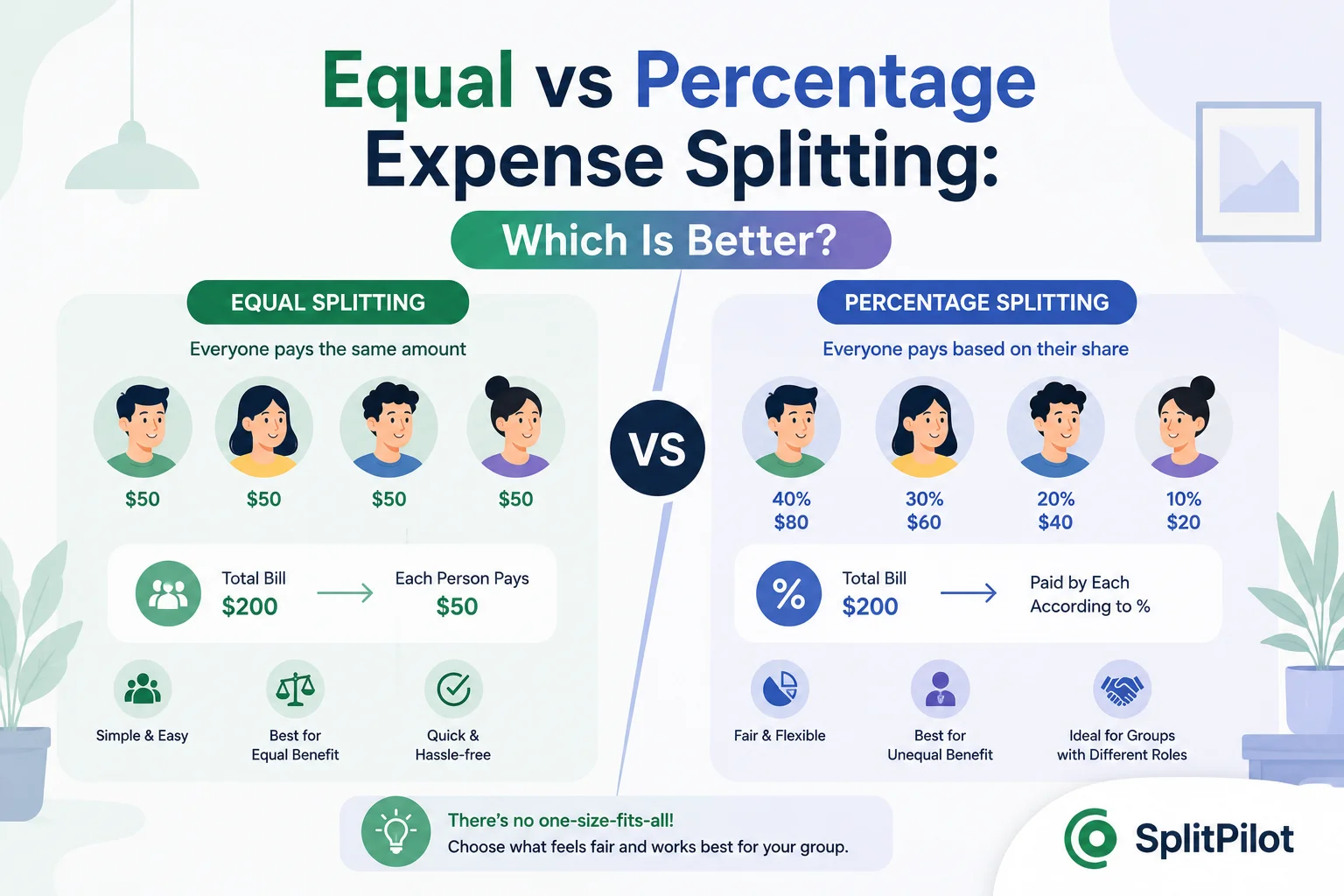
When living with friends, roommates, family or partners, one of the first things you have to make is a distribution plan for costs. Expense sharing can be a simple process, but the choice of how to do it can be significant both with regard to fairness and transparency.
The two most popular methods are expense splitting (equal cost) and percentage-based splitting. There are benefits to each method and in some situations one might be more appropriate than the other.
What is Equal Expense Splitting?
The easiest and most popular option is the equal expense splitting method. The overall expense is shared by everyone equally, whether or not they have a high or low income, or use and contribute to the group.
If 4 friends go out for dinner and each pays $200 for the dinner, then each person pays:
$200 ÷ 4 = $50
This is a method that can be used due to its simplicity of calculation and understanding. All people contribute the same amount of which is ideal when everyone is getting similar value from the expense.
Advantages of Equal Splitting
Quick and easy calculations
Easy to understand and monitor
Can be used for group excursions and activities
Decreases expenses complexity
Potential Drawbacks
May not feel it's always fair
Doesn't account for differences in income
Does not recognise that there are levels of use or participation.
For instance, if one roommate consumes way more utilities than the other, then an equal breaking down of the utilities may be incorrect.
Understanding the concept of percentage expense splitting.
The splitting of expenses on a Percentage basis, expenses are split based on the pre-determined percentages. These percentages could be based on income, use, or ownership, or other agreed on factor.
If a monthly expense costs $1000, and two people agree to contribute according to their income:
Person A pays 60% = $600
Person B pays 40% = $400
It is a technique frequently employed by couples, families and households with vastly different financial situations.
The benefits of Percentage Splitting.The pros of Percentage Splitting.
May be more equitable in terms of finances
Takes into account various income brackets
Appropriate for long term shared costs
Offers flexibility to accommodate special circumstances
Potential Drawbacks
There are more calculations needed
Percentages are to be predesignedated
Can make adjustments as needed when circumstances vary
Which Method is Better?
This is because there is no one right way to do it; it will depend on the situation.
Equal Splitting is the best option for:
Group vacations
Restaurant bills
Entertainment expenses
Shared transportation
Short-term group activities
In such situations, most people will get the same reward and it is easy and fair to split the reward equally.
Use Percentage Splitting Is Best For: when you want to compare two percentages.
Couples that are handling finances as a family.
When roommates have different room sizes.When roommates have a different size room.
Business people and their families living in different income brackets.
Long-term shared expenses
Under these circumstances, percentage splitting can achieve a more equitable financial arrangement.
Combining Both Methods
A lot of groups are comfortable with a blended model. Some costs may be divided equally, some may be divided by percentage.
For instance, internet expenses could be shared equally by roommates, and utilities expenses could be split according to the amount of use each person makes of them. Couples can allocate vacation expenses evenly but house expenses based on the income.
Final Thoughts
Expense splitting and percentage splitting is appropriate. Equal splitting is simple and convenient, percentage splitting is flexible and fair when contributions vary. The important point is to select the process that is suitable for your group and to keep it transparent. An expense-sharing tool, such as SplitPilot, can make either way easier by using this tool to calculate balances automatically and keeping everyone organized.